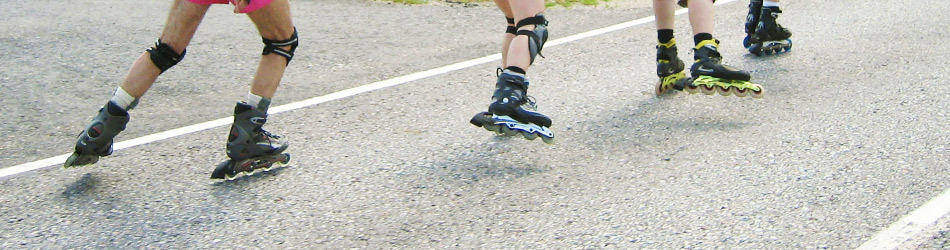
FinLine Skating FAQ
This page has been translated from the original Matkaluistelu FAQ in 2026. Although the “FinLine School” training program was executed in 2011, most of the questions and answers are still fully valid for FinLine. Only minor edits have been performed to correct some practices and rules that have been changed during the last 15 years.
General
What is the difference between “tour skating” and “long-distance skating” in Finnish?
In everyday language, “tour skating” (Finnish: retkiluistelu) most often refers to winter skating on natural ice. The term “long-distance skating” (Finnish: matkaluistelu) does not carry this same association, making it the better choice when talking about touring trips on inline skates.
I’m wondering whether my skating fitness or technique is good enough for FinLine. I wouldn’t want to just sit on the bus!
FinLine is skated at each person’s own “optimal pace.” You can skate with whatever technique you have — no one needs to focus constantly on clean execution. Your technique is only your own concern, not anyone else’s.
If you have managed a 50 km skating trip reasonably well, you can sign up for FinLine with confidence. Even though there are several consecutive skating days, the ability to rest whenever needed means you will spend the majority of the trip actually skating rather than on the bus.
And there is nothing shameful about riding the bus — on FinLine you are only on the road for one third of the day. The rest is even more enjoyable time together, with surprising domestic travel experiences you would never otherwise have.
Skating technique is only worth worrying about if you are prone to overuse injuries. In that case, make sure a flawed technique does not aggravate a problem as the journey goes on. A short rest on the bus can prevent things from worsening and save your skating for the rest of the trip. So hop on the bus without hesitation if you have even the slightest doubt!
Downhills
When a group descends a hill in a train formation (skaters drafting off one another), where should an uncertain skater be placed in the line?
Train formations are demanding and require calmness and cool nerves. An uncertain skater should not join the train at all. Instead, drop to the back of the group and set off alone down the hill only once the main train is halfway down. Following too soon risks catching the train and being forced to join it at speed, which requires skill.
Note: never overtake a downhill train even if you feel faster — when overtaking, the drafting effect disappears and the skaters end up side by side for a dangerously long stretch, possibly for the entire remainder of the hill.
The most demanding position in a train is the front. The lead skater has no support from anyone ahead and must monitor traffic, pick the skating line, and continuously assess potential hazards. They are also the last one who can brake or stand upright to slow the group, so sudden situations demand cool nerves and experience of how the train behind behaves. On bike paths, the front of the train must also take gentle enough lines through corners so that those at the back don’t slide off the asphalt.
It is tempting to place an inexperienced skater in the middle of the train, “supported by others.” This is not a good idea. Everyone in a train must hold themselves at all speeds without support. Hands in a train are not used to lean on others — instead, maintain a sufficient safety gap so each person has room to react if something sudden happens. An inexperienced skater in the middle may panic in a sudden situation or simply as speed increases, and any abrupt movements endanger everyone behind. New train skaters should therefore be placed at the tail, where they can get used to the speed and behavior of the formation.
The last skater can also drop out if the hill looks too daunting — just stand upright and let the airflow slow you down.
What should you do if your speed in a downhill train grows greater than what you can handle?
This is one of the greatest dangers on hills you have no previous experience with on skates. If there is reason to suspect that speed will become dangerously high, consider descending one by one with sufficient intervals between skaters. This is why it is worth studying the route map and terrain profile in advance.
Once the train is moving, leaving it is only possible for the last skater. Even then, standing up to drop out is usually inadvisable, since skating alone at high speed is even more challenging than following the train. Never break up a train purely because of unexpectedly high speed — the probability of getting down safely is still higher in formation than if the group scatters across the road at high speed.
Each skater has a maximum speed — depending on their skates, wheel size, and leg strength — beyond which the skates begin to wobble. Pay attention to your own skates when descending in a train. If they become unstable, focus entirely on your feet and adjust your stance to reduce the risk of your legs giving way or your skates hitting each other. The hill will end. The scenery can wait. Staying upright is what matters.
Uphills
How do you handle uphills on road skating trips? Some people climb steep hills much more slowly than others.
Avoid overtaking on uphills. It requires a lot of space, a hard sprint, and the crest of the hill may hide the skaters from oncoming drivers until it is too late. You may not even hear a car approaching from the other side. Think carefully about whether you can safely pass the skater ahead, given that a car could appear from over the brow at any moment.
Groups quickly learn how fast each person climbs. Faster climbers should move to the front before the uphill begins, when overtaking is still easy and visibility is good. Particularly slow climbers can help by making space before the hill starts.
Skating Groups
On longer trips, you skate in groups of at most five. How do groups form on FinLine? How fixed is the group split?
Groups form spontaneously at the start of each stage or event. Everyone can choose their preferred company and change groups daily or even during a stage, based on mood, energy, or simply for variety. When changing groups, always tell your previous companions so they don’t end up searching or waiting for you. On multi-day trips, remember this in the morning too if you want to skate with a different group.
Since the maximum safe group size on the road is five, you need to work out when switches are possible and agree on splitting groups when necessary. Because slower groups generally set off earlier than faster ones, switching from a faster group to a slower one may not be possible early in a stage without a ride on the support bus. The most natural time to switch is at a shared lunch or swimming break, when all groups are together.
Nowadays FinLine often begins with a shorter stage or “prologue,” making it easy to get to know the other participants and find good skating company. Groups therefore tend to form naturally on the morning of the first full skating day.
Even if a group is well-matched overall, some skaters start fast while others need a few kilometers to find their rhythm. How do you avoid the problems this causes?
Even when overall pace and style are similar, there can be big differences between skaters at the start of a stage or on uphills. This is perfectly normal and needs to be accepted on both sides. Over a long trip, tiredness can lead to minor friction — a relaxed attitude makes everything flow much more smoothly.
Don’t get frustrated if others pull away, and don’t get irritated if someone can’t keep up at first. The situation often evens out after a few kilometers. If there are several skaters in the group, consider splitting into two smaller groups based on starting pace or uphill pace.
The answer is not that skaters who start at full speed should slow down at the beginning of a stage or on uphills and proceed at exactly the same pace as the slowest. Everyone has a natural skating rhythm, and on a non-competitive trip like FinLine that rhythm conserves energy and maximizes enjoyment. Skating slower than your natural pace is just as tiring for fast skaters as skating faster is for slow ones. Slowing down does not always save energy.
Skating alone is not permitted. How can I then descend hills on my own if I don’t want to join a train?
Skating alone is prohibited so that skaters can look out for one another and help in case of problems. Lone skaters would also put extra strain on the support team just to track their whereabouts. In an accident, it is essential that other skaters are present to help and call for assistance. After a fall, assessing your own condition should always be left to others. Skating alone means skating in complete isolation. A group does not need to skate within touching distance — in fact, that is rarely advisable. Group members only need to know who is in the group and be able to see that everyone is alright. Visual contact is generally enough.
That said, avoid continuously leaving gaps of a hundred meters — everyone then has to push against the wind, making progress more tiring. Skaters far apart also struggle to communicate about problems or hazards they have spotted.
Equipment
What kind of wheels should you choose for the FinLine trip?
Larger wheels (100 mm or more) generally roll more easily on the rougher asphalt of country roads. The advantage increases on chipped or deteriorated surfaces, which are common on rural roads. Large wheels are less comfortable in cities, but the urban portion of FinLine is small.
Inline skates with 100 mm or 110 mm wheels are often sold with wheels that are hard for some Finnish roads — 85A, for example. Hard wheels roll efficiently but vibration drains energy quickly and can cause problems over a long distance. Wheels around 83A hardness are a comfortable starting point for beginners, though this is a matter of personal feel and no single rule applies to everyone. Heavier skaters need harder wheels to withstand the load; lighter skaters may need softer ones to reduce vibration.
For foreign participants, the advice is almost always the same: choose the softer option for FinLine. Skaters from southern countries often have no idea just how rough Finnish road surfaces can be.
What “extra items” are worth bringing to FinLine?
Since accommodation changes every day, extras are rarely worth the weight. Even for essential clothing, think about cutting quantity: there is no point starting a skating stage in completely fresh underwear or socks — the previous evening’s post-sauna set works perfectly well (assuming your sports underwear and socks are also suitable for evening wear). Thinking this way can meaningfully reduce what you carry.
A large part of FinLine time is spent in skating gear, so you need less other clothing than you might expect. You don’t need a fresh outfit every evening — two sets can cover the whole week. Beyond that, pack slightly smarter “going-out clothes” that can double for other occasions. There’s no need for nightclub-only attire — the traditional Street Gliders nightclub dress code is a Street Gliders black T-shirt and pants.
If you still feel compelled to bring extras, pack an outdoor or indoor game. They bring a lot of fun in the evenings, especially with foreign guests — the more exotic, the better. This tip is mainly for returning FinLiners; first-timers don’t need to worry about it, unless you happen to have something uniquely odd that nobody else could possibly bring.
Do you need two pairs of skates, or can you manage with one?
One pair is fine; two may be better. Either way, be prepared to repair, replace, and maintain parts such as bearings. A second pair is especially useful if your skates break mid-trip, and can also help if your feet become sore in the first pair.
Some people keep the first pair for good weather and the second for rain, so only the worse pair suffers from water and the need for bearing maintenance during the week is reduced.
My skates have been working fine. Why would they break down specifically during FinLine week?
For many participants, FinLine represents a large share of their annual skating kilometers and time on skates. It is therefore quite possible that a random failure occurs during the trip.
Check before you leave that both skates have plenty of brake pad remaining. Bring all available spare parts, including a spare brake pad — availability in rural areas is very limited.
What equipment should you have ready for a rainy skating day?
If you want to skate in any weather, be prepared either to clean your bearings after a wet stage or to have a separate pair of rain skates (with shielded bearings and/or a maximum of thick grease). You can swap skates on the support bus during a service stop — just keep the spare pair in the passenger compartment.
Resourceful skaters have also managed with one pair by swapping the wheels (and bearings) for a worse set when rain strikes. This usually takes more time than a group is willing to wait at a service stop, however.
Other useful wet-weather equipment: a rain- and wind-proof jacket you can also skate in; sealable plastic bags for phones, cameras, and similar items; plastic bags and duct tape to protect skates from mud and cold rainwater. Keep the small items in a hip bag at all times for sudden showers. The rest can be kept in the support vehicle and retrieved when rain starts or threatens.
Tip: A mud flap improves comfort and keeps the back of your clothing clean when skating on wet roads — and the skater behind you will appreciate a face free of spray. A mud flap is easy to make from duct tape: fold about 20 cm of tape in half lengthwise (sticky sides together), leaving the last centimeter unfolded for attachment. Stick it to the clean, dry heel of the skate just above the rear wheel. The flap may touch the rear wheel or stick out horizontally — while skating, the airflow keeps it from getting caught in the wheel.
What kind of skating outfit should you bring to FinLine?
FinLine participants can optionally order a short-sleeved skating shirt designed for FinLine. Wear it while skating — it is designed to stand out on the road, and the uniform color adds to the visual effect. In that case, you only need to choose suitable skating bottoms. Since this is not a competition, comfort is the main criterion. Tight Lycra works for those who prefer it; loose shorts work for others. Long tights are generally unnecessary in early July, though those who feel the cold may want to pack a pair.
If you did not order the optional FinLine shirt, use a FinLine shirt from a previous participation or choose your own shirt with a bright visible color.
For rain, keep a waterproof jacket in the support vehicle — one you can also skate in if needed. A swimsuit is not officially part of skating gear, but since swimming breaks are an important feature of FinLine’s hot days, a swimsuit in the support bus is practically essential.
Whatever you choose — jacket, long-sleeved top, or anything else — always pick a bright, visible color: red, orange, or yellow. On FinLine you may skate on a road where cars cover a hundred meters in four seconds. If a driver spends one second noticing a skater, a second processing the situation, and a third beginning to swerve, you want them to use that first second on the steering wheel. Make yourself visible. The most dangerous colors are black, dark blue, gray, and green.
Traffic
What can you encounter on the road at speed? Horses? Cattle? Reindeer? Combine harvesters?
All of these have been encountered during FinLine’s history — and there may well be new surprises still ahead. For machines and bicycles, the general rule is that oncoming traffic must give way to us. Stick to this where possible to avoid both parties swerving simultaneously. The important thing is that the person at the front of the group has road skating experience and can judge how to act safely in an encounter. This matters most on downhills, where the train leader must alone make a calm decision about whether to swerve or hold their line.
Swerving onto the roadway should be a last resort, especially on a downhill where you may not be able to see behind an oncoming vehicle to confirm that no one is overtaking it at the same time. That would create a second, more dangerous encounter in the middle of the road.
With animals, do not count on the other party swerving. Horses may not like skaters at all — and escaped young bulls certainly won’t — so stop in good time and wait for the road to clear. They are not encountered frequently enough for stopping to be a real hardship.
Reindeer in Lapland, on the other hand, tend to swerve far too early — many skater-tourists have missed photo opportunities. That said, watch out for “reindeer pee”: sometimes you catch them right just peeing a small lake on the middle of road.
Where on the road do you skate? Left side or right?
Under Section 13 of the Finnish Road Traffic Act, a skater must choose their position in the following order of preference, unless hazard or safety requires otherwise:
- Sidewalk
- Shared sidewalk and bike path
- Road shoulder (either side)
- Edge of a dedicated bike path (either side)
- Left edge of the roadway
- Right edge of the roadway
Under the law, a sidewalk and a shoulder, and a bike path and the roadway, are equivalent from a pedestrian’s perspective — but for practical reasons we have placed them in the recommended order above. On a bike path, keep primarily to the right-hand side for smooth flow.
A shoulder only exists where there is an edge line painted on the road; otherwise it is simply the edge of the roadway (Road Traffic Act, Section 2, point 6). Skating on the shoulder is often impossible because it is too narrow, so you also have to use the edge of the roadway. In practice this means skating specifically on the left-hand shoulder.
On FinLine, you skate primarily on the left side of the road. Switch to the right in good time, however, when forward visibility is limited and an oncoming vehicle would pose a particular hazard — for example on a winding downhill on a smaller road. Especially dangerous is a left-curving hill, or one that may curve left further down. Oncoming cars often cut the shoulder on the inside of a bend; with poor visibility, there is no reaction time left to avoid skaters.
The group leader makes the decision to switch sides before the descent begins, at a point with good visibility in both directions. This is another reason why someone with road skating experience should be at the front. Once the decision is made, the whole group switches quickly and together — so announce the intention clearly and loudly before moving.
Conditions
Roads often have poor surfaces. What can be done to reduce the problems, and has a section ever been skipped entirely because of a bad surface?
Poor or rough surfaces are felt most on uphills and into headwinds. When visibility is good and traffic is light, look for a smoother line in the wheel ruts or between them. On some sections you may need to shift your line continuously to avoid broken patches. Whatever you do, never get too close to the center line or let a skate tip cross to the other side — vehicles approaching from behind make this a serious risk.
When skating on the shoulder is not possible without hindrance, stay in single file and let the lead skater choose the line on the roadway. This prevents skaters from accidentally going side by side — even partially — which creates a tripping hazard and confusion if you suddenly need to swerve.
Even when the roadway edge is rough, always move back to the (left) edge in good time as vehicles approach from behind. A clear pull-over reduces uncertainty for drivers. Bear in mind that vehicles behind you may also be overtaking each other using the left-hand lane — illegal, but it happens. When skating on the roadway, continuously watch to the rear and call out loudly if any traffic is approaching.
Route planning cannot always avoid poor surfaces, since parallel road alternatives are rare in Finland. Thanks to the support bus, each person can decide whether to skate a bad section or not. As far as we can recall, no section has ever been skipped entirely because of a poor surface — or even the complete absence of one. There are always those for whom completing the full distance on skates under their own power is a point of personal honor, whatever the conditions.